The Underdog Show / 17 min read
He Became a CEO After 9 Years. Then He Walked Away to Build His Own SaaS.
From software engineer to COO, then CEO. Brian had climbed the career ladder many developers dream of. But after two years leading a company, he realized something was missing.
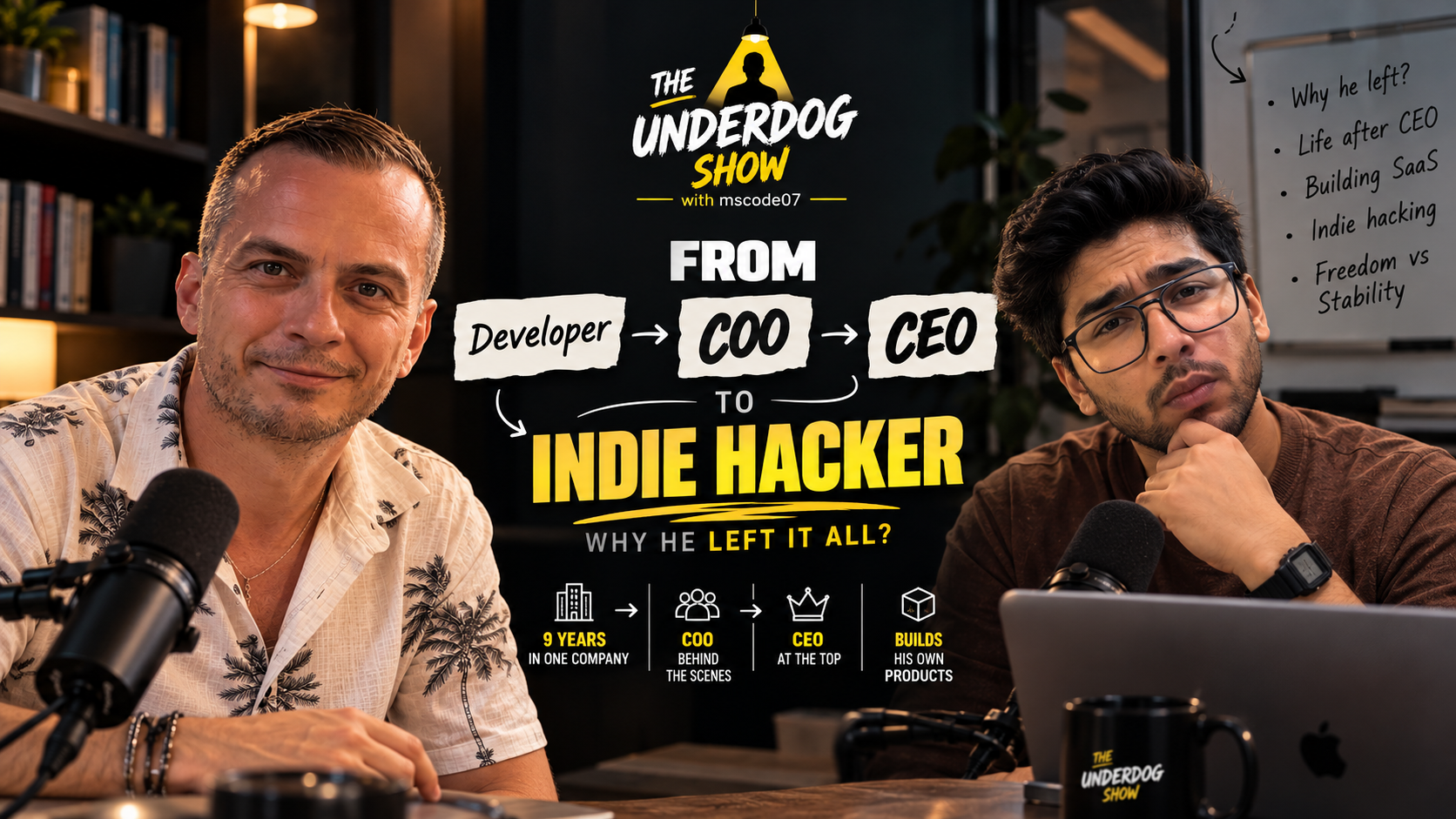
Imagine spending nine years working for a company.
You start as a software engineer, writing code and managing technical systems.
Over time, you take on more responsibilities. You start managing people, making decisions and understanding how the business operates.
Then one day, the opportunity comes.
You become the CEO.
For many people, that would be the dream.
A respected position. More responsibility. The opportunity to lead an entire company.
But what if reaching the top made you realize you wanted something completely different?
That's exactly what happened to Brian.
He spent nine years at a company operating between Australia and the Philippines, eventually becoming its CEO for two years.
Then he left.
Not to join another company.
Not to accept a better corporate position.
He left to build his own software products.
And the decision led him into a world of unpredictable revenue, expensive marketing mistakes, difficult customers and a completely different definition of freedom.
Today, Brian is a 35 year old indie hacker based in France. He has built multiple products, including an AI video generator that has earned approximately €30,000 in cumulative revenue.
But here's the interesting part.
Even after reaching around €3,000 in monthly recurring revenue, he still considers one of his biggest business goals a failure.
Why?
Because he was aiming for €10,000 MRR.
I invited Brian to The Underdog Show to understand how someone goes from being a software engineer to a CEO, why he would leave that position, and what it actually takes to build a profitable SaaS business.
His answers were different from what I expected.
From Software Engineer to CEO: The Opportunity He Didn't Expect
Brian's journey started long before he became an indie hacker.
Growing up in France, he was already interested in entrepreneurship and making money from his own ideas.
He also loved traveling.
That interest eventually took him to Australia, where he spent six years, and the Philippines, where he lived for another five.
During that period, he worked for a company with an office on Australia's Gold Coast and operations in Manila.
It was a recruitment business helping companies find people such as graphic designers, virtual assistants and video editors.
Brian was responsible for the technology.
He built and maintained the company's systems, handled its infrastructure and supported the people using those systems.
But he wasn't only writing code.
Without necessarily having the title, he was already taking on management responsibilities.
He understood how the company worked.
He communicated with employees.
And he had become someone the business depended on.
Then the company's CEO left.
The owner needed someone to step into the role.
And he gave Brian the opportunity.
Brian moved from software engineering into leadership, progressing through the COO role and eventually becoming CEO.
For two years, he was responsible for much more than software.
He had to understand marketing, customer acquisition, employees, revenue targets and business decisions.
It was the kind of opportunity many developers spend years working toward.
But Brian discovered something that isn't always obvious from the outside.
Becoming CEO doesn't mean you suddenly have control over your time.
Sometimes, it means the opposite.
The Reality of Being CEO Nobody Shows You
When I asked Brian what life was like as a CEO, I shared the image many of us have.
Traveling around the world.
Attending meetings.
Making big decisions.
Enjoying a successful lifestyle.
Brian laughed.
Then he explained what his days actually looked like.
Sometimes he would be out at a bar, spending time with friends, when his phone would start demanding his attention.
An employee needed something.
A customer had a complaint.
An urgent business issue needed a decision.
He couldn't simply ignore it until the next morning.
Some of the company's clients were paying around $2,000 to $3,000 per month for its recruitment services.
Losing even one important customer mattered.
And when acquiring new customers was already difficult, keeping existing ones became even more important.
So Brian kept answering messages.
During evenings.
During nights out.
Even when he was supposed to be relaxing.
The responsibilities didn't disappear when he closed his laptop.
He was still responsible for the business.
And that constant pressure slowly changed how he thought about success.
He had reached a position that many people wanted.
But he didn't feel free.
He had the title. He had the responsibility. But he didn't have the lifestyle he wanted.
And eventually, he had to make a decision.
Why He Walked Away From the CEO Position
Leaving wasn't about one bad day.
Brian described several reasons behind his decision.
The first was financial.
People often assume that being a CEO automatically means earning an enormous salary.
But his experience was different.
There were targets to meet and business responsibilities that affected the financial picture.
The second reason was personal.
He had always wanted to build something of his own.
He knew how software worked.
He understood how businesses operated.
And after years of managing systems and people, he believed he could create a successful product himself.
But the third reason was the most important.
Freedom.
He wanted to choose when he worked.
He wanted to travel without constantly depending on a paycheck.
And he wanted to stop feeling responsible for every emergency inside someone else's company.
So he and the company came to an agreement.
It was time for him to move on.
But leaving a CEO position and becoming a solo founder are two very different things.
As a CEO, he had a team.
As an indie hacker, he was on his own.
No employees to delegate work to.
No company infrastructure to rely on.
And no guarantee that anyone would pay for what he built.
So what happened when he finally started building?
His First Major SaaS Started With a Facebook Ad
Brian's main product is called Blippix, an AI faceless video generator.
The idea came when he saw a Facebook advertisement for a tool that could generate story videos using AI.
He was fascinated by what the technology could do.
At the time, building this kind of application required considerably more manual development than the AI assisted workflows he uses today.
So he decided to create his own version.
The first design was simple.
White and pink.
He wasn't even sure why he had chosen those colors.
But the design wasn't his biggest problem.
The application needed to generate videos reliably, handle multiple users and process requests through external APIs.
And the early version had issues.
When multiple customers tried generating videos simultaneously, the processing pipeline struggled.
Some videos failed.
Others took too long.
Brian kept fixing things while trying to attract his first customers through SEO and other marketing channels.
Slowly, people started signing up.
Then something happened that completely changed how he viewed the business.
One customer spent nearly $1,000 on a yearly subscription.
And that wasn't the end of it.
The Customer Who Spent Thousands in One Evening
The customer was a business owner from France.
He ran a translation company and had discovered Blippix.
Instead of simply buying a subscription and disappearing, he started talking to Brian.
They exchanged messages.
Then they moved to WhatsApp.
Eventually, they spoke on the phone.
The customer shared feedback.
Brian listened.
When something wasn't working, Brian tried to fix it.
When the customer suggested a useful feature, Brian worked to implement it quickly.
Their relationship became more personal than a typical interaction between a software company and a subscriber.
They were two entrepreneurs discussing problems and solutions.
Then one evening, the customer created multiple accounts for his business.
And purchased several yearly subscriptions.
Brian recalls the customer spending around $4,000 to $5,000 in that single evening.
For a relatively new SaaS product, that was a remarkable moment.
It showed him that people were willing to spend serious money on the problem he was solving.
But when I asked how he convinced someone to spend that much on an application that still had technical issues, his answer wasn't about clever pricing or a perfect sales funnel.
It was about trust.
He had been available.
He had listened.
He had responded to problems.
And the customer believed Brian would keep improving the product.
That's something worth remembering as a founder.
Sometimes your biggest competitive advantage isn't another feature.
It's the relationship you build with the people using your product.
But Brian's next customer story was even more unexpected.
A Cancelled Subscription That Turned Into a Business Opportunity
Most SaaS founders hate seeing subscription cancellations.
A customer leaves.
Monthly recurring revenue drops.
And the usual response is to focus on replacing that customer with someone new.
Brian approaches things differently.
When a customer from the United States cancelled his Blippix subscription, Brian contacted him to understand why.
They got on a call.
The customer explained that he had misunderstood how the product's video generation credits worked.
He expected fully animated videos to cost the same number of credits as videos using static images.
But generating animated video clips required additional processing and credits.
That difference hadn't been clear enough.
The customer still decided to leave.
But Brian didn't treat the conversation as a waste of time.
They stayed in contact.
And later, something unexpected happened.
That former customer introduced Brian to a mobile application development project.
Brian told me he had already received funds for the development work.
A customer who had cancelled his subscription became the connection to a new freelance opportunity.
It's a small story, but it says a lot about the way Brian operates.
He doesn't see customers as numbers on a dashboard.
He sees them as people.
And those relationships can sometimes become valuable in ways that have nothing to do with the original subscription.
€30,000 in Revenue, but He Still Missed His Goal
Over time, Blippix grew.
Brian reported approximately €30,000 in cumulative revenue from the product.
At its peak, it reached around €3,000 in monthly recurring revenue.
For someone building software independently, that's a meaningful achievement.
But Brian wasn't completely satisfied.
His original goal had been €10,000 MRR.
He hadn't reached it.
And the path to €3,000 MRR hadn't been cheap.
He had spent significant money experimenting with Facebook advertising.
Some campaigns worked.
Others became expensive lessons.
Eventually, he started questioning whether paid advertising was the best way to grow his products.
He already had experience with search engine optimization.
So he decided to rely more heavily on organic traffic.
But before he could make SEO work for his newer products, he made a mistake that affected Blippix.
A mistake that changed his entire approach to growing websites.
The SEO Mistake That Changed Everything
Brian had been using programmatic SEO.
The idea was to create landing pages targeting different search terms and use cases.
He created hundreds of pages.
Then he decided to translate the website into multiple languages, including French, Spanish and Chinese.
What started as approximately 300 pages expanded to around 1,200.
More pages.
More keywords.
More opportunities to appear in search results.
At least, that was the expectation.
Then Blippix was affected by a Google spam update.
Brian believes the large volume of repetitive pages contributed to the problem.
It was an expensive lesson in how easily an SEO strategy can become focused on publishing more rather than publishing better.
He realized that generating hundreds of similar pages wasn't the same as creating useful content.
So he changed his approach.
Instead of relying on page volume, he began focusing on content quality, clear website structure, useful free tools and relevant internal links.
And when he applied that approach to his other products, he started seeing encouraging results.
But the most interesting example came from a website he had almost forgotten about.
He Left a Product Alone for Six Months. Then Sales Started Coming In.
One of Brian's other products is Bit Motion.
After building the website and doing some initial SEO work, he left it largely untouched for months.
He wasn't constantly launching new campaigns.
He wasn't checking it every hour.
He had other things to work on.
Then, after around six months, something started happening.
He began receiving sales notifications.
Not every day.
But regularly enough to surprise him.
During our interview, he said new subscriptions were arriving roughly every two or three days.
The product had started gaining traction without the constant attention he expected it would need.
Brian described how the revenue chart had been relatively flat before suddenly moving upward.
He reported that Bit Motion had generated close to €1,000 in cumulative revenue, with approximately €400 MRR at the time of our conversation.
It wasn't his biggest business.
But it reinforced an important lesson.
Sometimes a product needs more time before you can fairly judge whether its SEO strategy is working.
Of course, waiting alone isn't a growth strategy.
The product still needs to solve a real problem, and its website needs to give search engines something useful to discover.
But Brian had seen founders abandon products after a few weeks because they weren't receiving traffic.
His experience convinced him that some of them were giving up too early.
So I decided to challenge him.
I Asked Him to Grow a Brand New SaaS From Zero
During the podcast, I gave Brian a hypothetical situation.
Imagine you've just built a product.
The website is live.
You have a domain.
But you have zero users.
How would you start marketing it?
What would you do first?
Brian's response was practical.
He would start with the brand and homepage.
Not just making the website look attractive, but making sure visitors could understand the product and its value.
Then he would focus on helpful content written in simple language.
He emphasized using credible sources when making factual claims and creating pages that genuinely answer users' questions.
From there, he would build free tools related to the product's niche.
He would publish supporting articles and connect them through relevant internal links.
He would also work on earning visibility through product directories, launch platforms and backlinks.
And he wouldn't ignore Bing.
Brian said he had received meaningful traffic from Bing and considered it an underrated source of visitors.
His approach wasn't about discovering one secret SEO trick.
It was about building a useful website, making it easier to discover and allowing the work to compound over time.
But SEO wasn't his only acquisition channel.
He was also experimenting with something many founders dislike.
Cold email.
Sending Hundreds of Cold Emails to Find Customers
Brian told me that he uses cold outreach to promote his launch platform, Launch It.
At first, he hadn't expected cold email to work particularly well.
Like many of us, he assumed most people would ignore the messages or mark them as spam.
But he experimented anyway.
He built an automated outreach process and focused on keeping the messages short.
His approach was to communicate a relevant problem and explain the solution without making the email unnecessarily long.
He reported sometimes sending approximately 300 to 400 emails per day and receiving responses and sales.
That doesn't mean the same volume or approach will work for every business. Outreach needs to be relevant and compliant with applicable rules.
But his experience challenged an assumption he had made.
A marketing channel he thought was ineffective turned out to be useful for his product.
And that brought us to one of the biggest changes in software development today.
AI Made Building Easier. It Didn't Make Getting Customers Easy.
Brian started Blippix when building an AI powered application required substantial development work.
Today, he uses AI coding tools to build much faster.
He shared an example of creating another product, Dear Pilot, in just two or three days.
For him, that speed is exciting.
But it creates a new problem for founders.
If more people can build applications quickly, more products will compete for the same attention.
A functional website is no longer enough to stand out.
Your brand matters.
Your design matters.
Your offer matters.
And most importantly, people need a reason to trust you.
Brian has become increasingly focused on the things that happen after development.
Finding customers.
Talking to users.
Improving positioning.
Trying different distribution channels.
And turning occasional sales into a sustainable business.
His experience as a CEO helped him understand that building software and building a business require different skills.
But there's one more thing I wanted to understand.
After everything he'd experienced, did leaving the CEO position actually give him the freedom he wanted?
Did Leaving His CEO Job Really Give Him Freedom?
When I asked Brian about his life today, he admitted that he still works extremely hard.
He's responsible for his products.
He handles customer support.
He writes code.
He works on SEO.
He experiments with marketing.
And he still needs to generate enough income to support himself.
But there's a difference.
Some mornings, he starts work at 7.
Other days, he starts at 10.
He chooses which products to work on.
He decides what goals matter most.
He can organize his day around his own priorities.
That doesn't mean every day is easy.
Some days bring hundreds of dollars in sales.
Others bring very little.
Sometimes a product makes a sale while another remains quiet.
Brian shares both kinds of days on X.
And that was something I appreciated about his journey.
He doesn't only share the impressive revenue screenshots.
He also talks about mistakes, missed targets and disappointing days.
Because building a business rarely looks like a smooth line moving upward.
Sometimes you spend months working without knowing whether anything will come from it.
Sometimes you lose a customer.
Sometimes you make a marketing mistake.
And sometimes, after months of waiting, the sales finally begin arriving.
The Advice He Would Give Someone Who Is Still Struggling
Near the end of our conversation, I asked Brian what he would tell younger founders who are working hard but haven't seen meaningful results.
His answer was simple.
Most people give up too early.
He has spoken with founders who launch a product and quickly become frustrated because nobody is buying it.
Some assume the market is bad.
Others believe SEO no longer works.
Some decide they simply aren't good enough.
Brian sees things differently.
Sometimes the product needs improvement.
Sometimes the offer isn't convincing.
Sometimes the marketing channel is wrong.
And sometimes potential customers simply haven't had enough time to discover and trust the founder.
He described business as a puzzle.
Your product, positioning, marketing and customer experience all need to work together.
If one important piece is missing, the entire business can struggle.
His advice wasn't to keep doing the same thing forever and hope for different results.
It was to keep learning, testing and improving instead of giving up at the first sign of difficulty.
And after listening to his story, that advice carried more weight.
Because Brian has experienced the pressure of leading a company.
He's left a position that many people dream of reaching.
He's built software that customers pay for.
He's made expensive mistakes.
He's missed revenue goals.
And he's still trying to grow.
What Brian's Journey Taught Me
As a developer and indie hacker myself, I found this conversation especially valuable.
We often imagine that the next achievement will finally make everything easier.
Getting a developer job.
Becoming a senior engineer.
Getting promoted.
Becoming a CEO.
Launching a product.
Reaching the first $1,000 MRR.
But every new stage brings a different set of problems.
Brian reached the CEO position and discovered that the title wasn't giving him the life he wanted.
He became an indie hacker and discovered that building a product was only one part of running a business.
He learned how powerful customer relationships can be.
He learned that more SEO pages don't necessarily mean better search performance.
And he learned that sometimes progress happens long after the excitement of launching has faded.
Success isn't always about reaching the highest position or making the most money. Sometimes it's about building a life where you have more control over your own time.
Brian is still working toward that life.
And that's what makes his story worth following.
Watch Brian's Full Story on The Underdog Show
This article covers the journey, but some of the most interesting parts are in the conversation itself.
In the full episode, Brian explains how he moved from software engineer to COO and CEO, why he eventually left, how he built Blippix, and what happened when a single customer spent thousands of dollars on his product.
We also discuss the SEO mistake that affected his website, how he approaches growing a new SaaS from zero, why he believes founders abandon products too quickly, and how AI is changing the challenge of building a successful software business.
There's also a conversation about my own product idea and what Brian thinks about its potential.
Watch the full episode of The Underdog Show on YouTube:
Watch Brian’s full episode on YouTube
If you're a developer, indie hacker, solo founder or someone thinking about leaving a traditional career to build your own product, I think you'll find something useful in Brian's experience.
Because his story isn't about someone who figured everything out.
It's about someone who reached the top of one career, decided it wasn't what he wanted, and had the courage to start building something of his own.
Real people. Bigger stories.
The Underdog Show with mscode07