The Underdog Show / 10 min read
He Said No to Forbes. Now He Is Teaching Himself to Build a SaaS.
Pasha’s journey from photography and UX design to learning to code and building Honey Traffic alongside work and family.
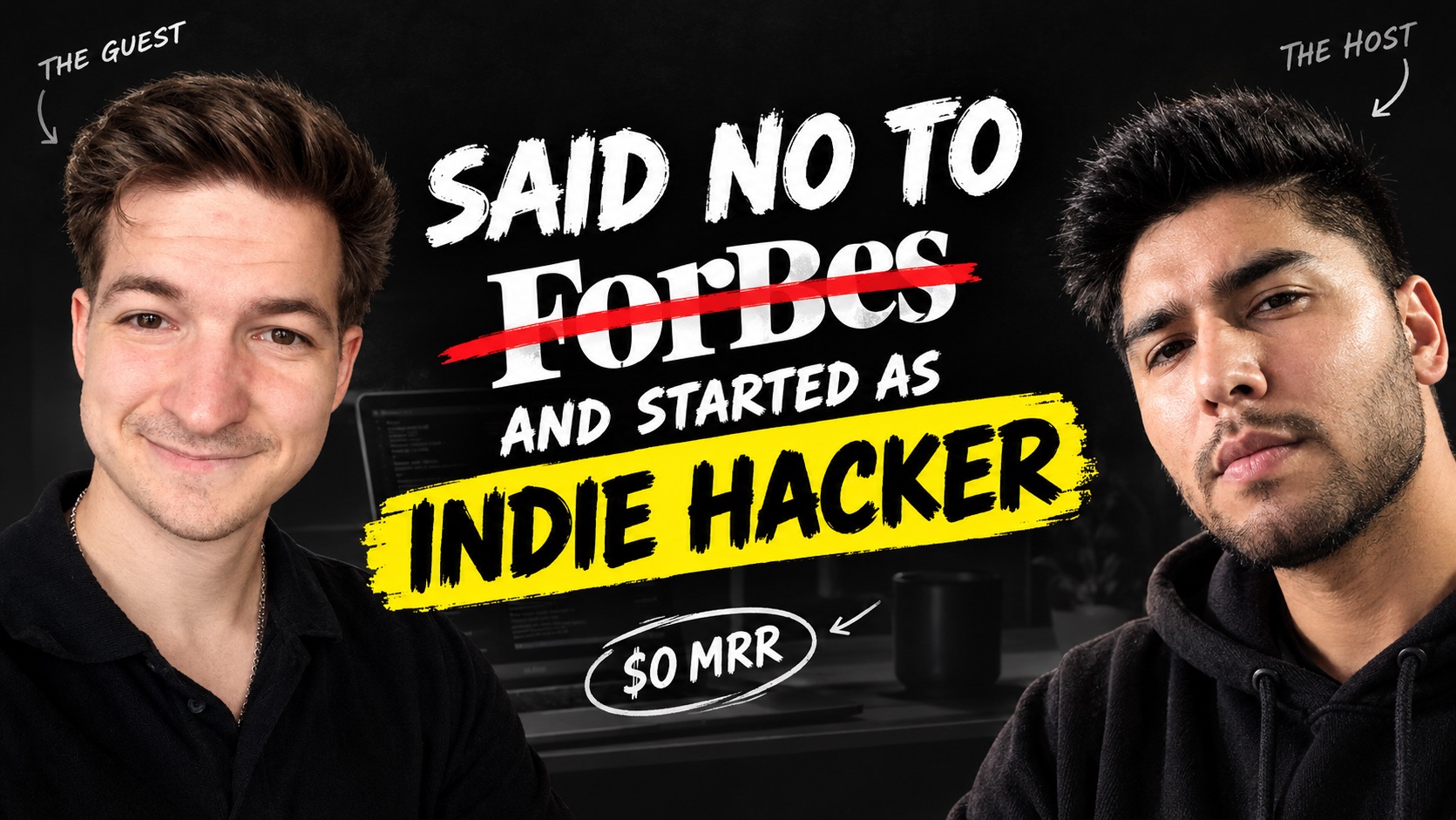
Graphic designer. Photographer. Senior UX designer. Husband. Father. And now, indie hacker.
At 26, Pasha has already changed directions more times than many people are willing to do in their entire careers.
But there is one part of his story that caught my attention.
At one point, he had the opportunity to become a main photographer for Forbes in Slovakia.
He said no.
Not because photography had failed him.
Actually, it was going pretty well.
He had photographed successful business people and millionaires. He had built experience, clients and a career around his creative skills.
But meeting those successful people made him start asking himself a completely different question:
"Are these people actually smarter than me?"
That question eventually changed the direction of his life.
Today, Pasha works as a senior UX designer, spends time with his family, still does photography and then, often at night, opens his laptop and works on his own SaaS product.
There is another interesting detail.
He comes from a non technical background.
So why would someone who spent years building a creative career suddenly decide to learn coding and become an indie hacker?
That's what we explored in Episode 2 of The Underdog Show.
It Started With Art, Not Code
Pasha didn't grow up thinking he would become a software developer.
He loved creative work.
Painting interested him.
Then came graphic design.
He taught himself Photoshop and started creating banners and other designs.
Eventually, his interest moved toward photography.
He loved the artistic side of it, but there was a problem.
Making stable money from photography wasn't easy.
His then fiancée, now his wife, suggested that he find stable work.
So Pasha did something that would later become a pattern throughout his life.
He didn't completely abandon one thing for another.
He did both.
He worked a regular job in graphic design while continuing photography on the side.
Then graphic design introduced him to something new.
UX and UI design.
This was different.
It wasn't only about making something beautiful anymore.
It was about understanding how people interact with what you create.
Pasha became fascinated with the idea that someone could actually touch, use and experience something he designed.
He started learning.
Junior designer became mid level designer.
Eventually, he became a senior UX designer.
But at the same time, something interesting was happening with his photography career.
Photographing Millionaires Changed How He Thought About Money
Pasha chose business portraits as his photography niche.
That decision eventually gave him opportunities to photograph people for Forbes Slovakia.
Suddenly, he was meeting people with businesses and significant wealth.
He could talk to them.
Observe them.
Understand how they thought.
And he started wondering:
Why are they financially successful?
Was it because they were dramatically smarter than everyone else?
His conclusion was different.
It was often about the business model.
That realization exposed a limitation in his own photography business.
If Pasha wanted to earn more from photography, he generally had to work more.
More clients meant more shoots.
More shoots meant more travel.
Then came editing.
His income remained closely connected to the number of hours he personally worked.
So another question appeared:
Could I build something where my income isn't directly tied to every hour I work?
That question slowly pushed him toward software.
Then He Discovered Indie Hacking
In late 2025, one of Pasha's previous photography clients approached him about joining a startup.
The idea was to build a dating application and eventually raise venture capital.
Pasha contributed his UX expertise and spent months working with the team.
But the funding they expected kept getting delayed.
Promises of raising money continued.
That experience pushed Pasha to research the startup world himself.
And he discovered something he hadn't really understood before.
You didn't necessarily need to raise millions from investors to build a company.
There were people on the internet building small software products themselves.
They were launching them.
Getting customers.
Making money.
And keeping control of what they built.
Bootstrapping.
Pasha discovered creators such as Marc Lou and the stories shared by Starter Story.
Suddenly, indie hacking didn't look like some distant world reserved for Silicon Valley founders.
Maybe he could do it too.
There was only one problem.
He Was Scared of Coding
This might be my favourite part of Pasha's story.
For years, he believed coding wasn't for people like him.
He saw himself as an artist.
A creative person.
Someone interested in photography, visual design and abstract ideas.
Programming felt like something for people who were naturally good at mathematics and logic.
And that fear wasn't new.
When Pasha was around 15 and had recently moved to Slovakia, someone he met was building websites.
The person gave Pasha a programming book and encouraged him to learn.
Pasha never read it.
He was scared that coding would be too difficult.
Years later, he found himself facing the exact same fear.
Except this time, he didn't run away from it.
He started learning.
Courses.
JavaScript.
Online tutorials.
AI.
Questions to developers.
Lots of mistakes.
Things that might take an experienced developer minutes could become an entire research session for him.
APIs were confusing.
Technical setup was frustrating.
But he kept going.
And eventually he started building.
His First Product Failed Quietly
Before his current SaaS product, Pasha experimented with a real estate idea.
The concept came from his photography background.
Real estate agents need good property images, so he wondered whether AI could help improve those photos automatically.
The idea made sense on paper.
Building it was another story.
Finding an API capable of reliably enhancing existing property images was difficult.
Getting useful material from photographers was difficult.
Then came customer acquisition.
Pasha contacted real estate professionals on LinkedIn.
Almost nobody responded.
Eventually, he killed the product.
There wasn't a huge public failure.
No dramatic launch post.
No viral postmortem.
It simply didn't work.
So he moved on.
And this time, he chose a problem he understood much better.
Building Honey Traffic
Pasha had spent years maintaining his photography website.
And like almost every person trying to grow a website, he eventually ran into SEO.
How do you rank?
How do you write useful articles?
How do you consistently publish content?
How do you turn search traffic into customers?
That experience eventually became the foundation for Honey Traffic, the SaaS product he is currently building.
Honey Traffic is an SEO tool designed to help founders create and publish articles while growing their organic search traffic.
But Pasha said something during our conversation that I found refreshing.
He didn't pretend he had invented an entirely new category.
There are already many SEO tools.
He knows that.
His approach is to study what already works and then use the skill he understands deeply:
UX.
Instead of trying to reinvent everything, he wants to find places where existing products provide a poor experience and make those parts better.
He's also focused heavily on the quality of generated articles.
He doesn't want users opening an article and immediately thinking:
"This is AI slop."
He wants the writing to feel like something the person themselves could have written.
But Honey Traffic comes with another challenge.
Finding the time to actually build it.
A 9 to 5, Photography, Family and a SaaS
This is the part of indie hacking that doesn't always fit into a beautiful "build in public" screenshot.
Pasha has a job.
He has meetings.
He still has photography work.
He has a wife.
He has a young son.
And then there is Honey Traffic.
Sometimes that means building at night after everything else is finished.
He openly shares those days on X.
Some days are productive.
Some days aren't.
Sometimes there is progress.
Sometimes there is self doubt.
During one particularly difficult period, his wife told him something simple.
She doesn't completely understand the world of indie hacking or making money on the internet.
But she understands him.
She had already watched him build his photography business.
She had watched him become a skilled UX designer.
So her message was essentially:
If this is something you really want, keep going.
Sometimes that's enough.
From 60 Followers to Around 1,500
Pasha also started sharing the process publicly on X.
When he returned seriously to the platform in June 2026, he had roughly 60 followers.
Within a few months, that had grown to around 1,500.
But his strategy wasn't simply:
"Post more."
He started by helping people.
With years of UX experience behind him, Pasha offered to review people's websites.
One post led to around 10 to 12 website reviews.
He recorded detailed feedback on landing pages and, in some cases, the actual products.
He didn't begin by asking the community to buy something.
He gave people something useful first.
Some of those interactions turned into genuine relationships.
And when Pasha gets stuck on technical problems today, people from that same community help him.
Not generic tutorials.
Real people looking at his actual problem and explaining what he should do next.
That's one of the reasons he continues building in public.
The audience matters.
But the people behind those follower numbers matter more.
Why Not Just Become a Creator?
Growing an audience can itself become a business.
X has creator payouts.
There are sponsorships.
There are brand deals.
There are many ways to monetize attention.
Pasha understands that.
But that's not his primary goal.
Because, in his eyes, becoming a creator can turn into another job where income depends heavily on constantly posting and engaging.
He wants the audience.
He wants the community.
But ultimately, he wants to build products.
And behind that goal is something much more personal than becoming a famous founder.
He Isn't Chasing a Lamborghini
When I asked Pasha what really motivates him to keep working on Honey Traffic after his job and other responsibilities, his answer was simple.
Financial freedom.
Not becoming unbelievably rich.
Not showing off online.
Not chasing some founder lifestyle.
He wants enough financial security that his family doesn't have to constantly think about money.
That's the goal.
And perhaps that's why he's willing to work through the uncomfortable stage where nothing is guaranteed yet.
Honey Traffic isn't a massive company.
There is no huge exit story here.
The product wasn't even fully launched when we recorded the conversation.
Pasha is still figuring things out.
And that's exactly why I wanted him on The Underdog Show.
"Just Human"
Near the end of our conversation, I asked him something.
After being a graphic designer, photographer, UX designer and now indie hacker, what does he actually call himself?
His answer surprised me.
"Just human."
Photography once felt like something he would do forever.
Then life changed.
Now he loves indie hacking.
Maybe that changes someday too.
And he doesn't want to trap himself inside another identity.
There's something worth remembering there.
You don't have to spend your entire life being the person you decided to become at 18.
You can change.
You can learn something completely different.
You can fail at one product and build another.
You can be an artist and learn to code.
You can have a job and still build something of your own.
And you don't need to know exactly where all of it will lead.
The Advice He Would Give His Younger Self
At the end of the episode, I asked Pasha what he would tell his younger self.
His answer came back to that programming book he never opened at 15.
Don't be scared to try things.
Don't be scared of big things.
Pick up the book.
Start learning.
Looking at his journey now, it's interesting to imagine how different things might have been if that 15 year old had opened it.
But maybe that's not the point.
Because eventually, he did start.
And now he's building.
Watch the Full Story on The Underdog Show
This article only covers part of my conversation with Pasha.
In the full episode, we talk about his journey from graphic design to photography, working with Forbes Slovakia, meeting successful entrepreneurs, becoming a senior UX designer, discovering indie hacking, being afraid of coding, learning development from scratch, his failed real estate product, building Honey Traffic, SEO, building in public, growing on X, family, self doubt, financial freedom and the reality of building a SaaS while working a full time job.
And some of the best parts aren't really about SaaS at all.
They're about having the courage to change direction when the life you're building isn't the life you actually want.
🎙️ Watch Episode 2 of The Underdog Show on YouTube:
Watch the full conversation with Pasha
If you're a developer, designer, indie hacker, SaaS founder or someone thinking about building your first product, I think you'll find something useful in Pasha's story.
And if you've ever thought:
"I'm not technical enough to build something."
You should definitely hear what Pasha has to say.
Real people. Bigger stories.
The Underdog Show with mscode07