The Underdog Show / 11 min read
He Left Ukraine, Built His Own Products, and Now Fears AI Could Replace His Job
From escaping rocket attacks with a newborn baby to building software after his full time job. This is Petro's story of starting over, learning to sell, and navigating an uncertain future in tech.
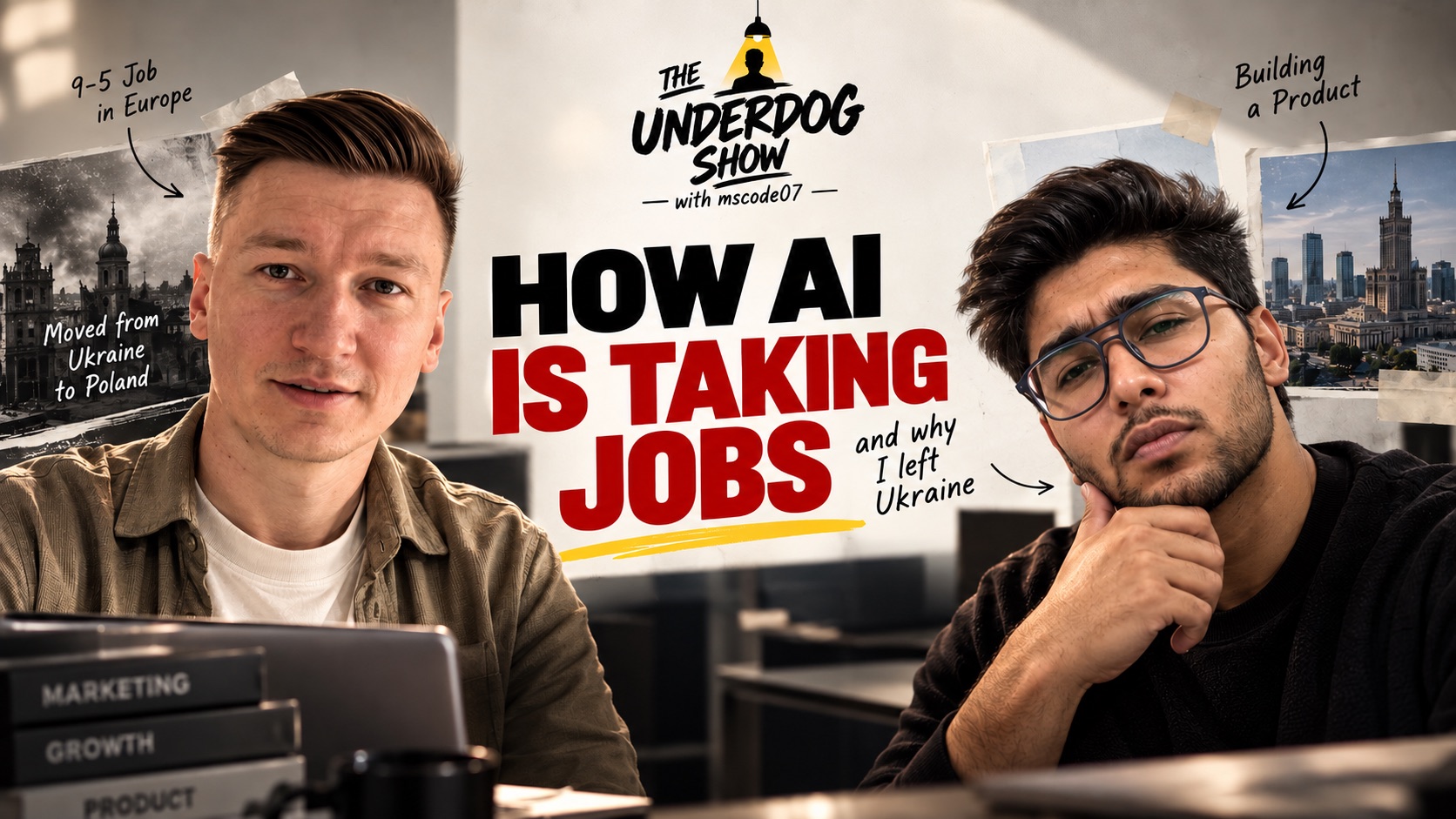
Imagine having to leave your home because of war.
Your baby is just one month old.
You don't know what will happen next or when you'll be able to return.
You pack your belongings, leave your country and try to build a new life somewhere else.
Now imagine doing all of that while trying to maintain your career, support your family and continue pursuing your dream of building your own products.
That's part of Petro's story.
Petro is a software developer from Ukraine. He works full time, builds side projects and shares his journey with the developer community on X.
He has been writing code for more than a decade.
He has built websites, sold digital templates, experimented with 3D applications and launched his own products.
But when I asked him about sales from his current main product, his answer was surprisingly simple.
"Honestly, I didn't sell."
And there's another thing.
Despite years of experience as a developer, Petro admits that AI sometimes scares him.
Not because he doesn't understand it.
But because he understands how powerful it has become.
For this episode of The Underdog Show, I sat down with Petro to talk about his journey from Ukraine to Poland and Spain, his experience building software products, the difficulty of marketing, and what it feels like to be a developer during the AI revolution.
His story is about much more than programming.
It All Started With One Question: What Is a Website?
Around 2014 or 2015, Petro became curious about something most of us use every day.
Websites.
He could see the text, images and buttons on his screen.
But he couldn't understand what was happening behind them.
So he asked a friend who already knew how to build websites.
His friend opened a folder on his computer and showed him some files and images.
Then he said something that confused Petro even more.
"This is the website."
Petro didn't believe him.
How could a folder containing files become an entire website?
That curiosity pushed him to start researching.
First came HTML.
Then CSS.
Then JavaScript.
And eventually, he started building websites himself.
He loved frontend development because it felt like magic.
You write something in an editor, refresh the browser, and suddenly something appears on the screen.
That feeling kept him learning.
He started creating small websites for friends, experimenting with different programming languages and exploring what he could build.
But he didn't want to stop at learning how to code.
He wanted to create something people would actually use.
Eight Rejections Before His First Online Business
In 2016, Petro and his girlfriend, who is now his wife, decided to build something together.
She was learning web design, and he was learning development.
So they combined their skills.
Their idea was simple.
Create website templates and sell them on ThemeForest.
They decided to focus on wedding website templates.
But getting their first product approved wasn't easy.
Their first template was rejected.
They fixed it and submitted it again.
Rejected.
They made more changes.
Rejected again.
This happened eight times.
Imagine spending months working on something, only to receive another rejection every time you submit it.
Many people would have abandoned the project.
Petro didn't.
Instead, each rejection motivated him to improve the product and try again.
Eventually, their template was approved.
And people started buying it.
Over the years, their templates generated around $14,000 in marketplace sales before commissions.
It wasn't life changing money.
But it was real.
They used some of that money to travel and buy equipment, including laptops.
More importantly, Petro experienced something that every indie hacker wants to experience.
People were paying for something he had built.
And because the templates could continue selling after publication, the project didn't require him to work directly with every customer.
It was his first real experience with earning money from a digital product.
But while he was building his career, life was about to change in a way he could never have predicted.
Leaving Ukraine With a One Month Old Baby
In 2022, Russia's full scale invasion of Ukraine changed Petro's life.
At the time, he and his wife had a baby who was only one month old.
During our conversation, Petro talked about hiding from rocket attacks.
And something he said stayed with me.
When you're alone, you might think about your own safety.
But when you have a newborn child, everything changes.
Your biggest fear becomes what might happen to your family.
So Petro and his wife made a difficult decision.
They left Ukraine.
Their first destination was Poland.
They moved there because of the war and started rebuilding their lives.
Fortunately, Petro was able to continue his career as a developer.
The company he worked for had also opened an office in Poland, allowing him to relocate and continue working.
Poland eventually became home for several years.
He learned Polish, met developers, attended tech meetups and became part of the local technology community.
Living in Kraków also exposed him to a growing tech ecosystem.
There were offices of major technology companies and developers working on products used around the world.
For someone who loves building software, being surrounded by that environment was motivating.
But their journey didn't end in Poland.
Starting Over Again, This Time in Spain
When we recorded the podcast, Petro and his family had recently moved to Spain.
They had been there for only about two weeks.
They were still looking for ways to transport their belongings from Poland.
They had just found an apartment.
They needed furniture and household essentials.
And through all of this, Petro was still working his regular developer job.
After work, he tried to find time for his personal projects.
Think about that routine.
A full time job.
A family.
A new country.
A new language.
Moving responsibilities.
And then, whenever time allows, opening the laptop to build something of your own.
That's the side of indie hacking that rarely appears in revenue screenshots or startup success stories.
Sometimes building a product means working for an hour after an exhausting day.
Sometimes it means making almost no progress because life has other priorities.
Petro understands that reality.
And he's still trying.
Building Products Without Knowing How to Sell Them
One of Petro's main projects is a tool called Preview.net, an online product preview builder.
The idea came from a problem he experienced while selling templates on ThemeForest.
Every time he uploaded a template, he had to create promotional images and previews to showcase the product.
It was repetitive work.
So he decided to build a tool that could make the process easier.
The application allows users to create product preview images using existing sections and a visual editor.
They can change text, fonts, images and other elements without designing everything from scratch.
Petro originally built it to solve his own problem.
Later, he realized other developers might have the same issue.
During a developer meetup, someone mentioned struggling to create preview images for a mobile application.
Petro already had a tool that could help.
That was an encouraging moment.
But building something useful and turning it into a successful business are two different things.
When I asked Petro how much money the product was making, he admitted that he hadn't made sales from it.
In fact, he hadn't even added a payment feature yet.
He was still collecting feedback and improving the experience.
Some users found parts of the interface confusing.
Others felt that the customization panel contained too many options.
So he went back to improving the product.
But during our conversation, he admitted something that many developers struggle with.
"I know how to build it, but I don't know how to sell it."
And I could relate to that.
As someone who builds products myself, I've experienced how difficult it can be to get users and customers.
You can spend months writing code.
You can create something that works perfectly.
You can launch it publicly.
And still struggle to convince people to pay for it.
Because building a product doesn't automatically mean you've built a business.
Marketing, distribution, positioning and understanding customers are skills of their own.
Petro knows that now.
And learning those skills is one of his biggest goals for the future.
Why He Still Builds Projects for Fun
Not everything Petro builds is intended to become a business.
One of his other projects is a 3D virtual city where people can rent digital buildings to showcase their products.
The idea came from seeing another creative project on X.
Petro wanted to experiment with Three.js and understand how to create interactive 3D experiences.
So he built something.
Not because someone asked him to.
Not because he had a business plan.
But because he was curious.
He has also experimented with game development using Unity.
And that's something I found interesting about his journey.
Even after years of professional development experience, he still approaches new technologies with the curiosity of someone learning to code for the first time.
He doesn't always need a financial reason to build.
Sometimes he just wants to understand how something works.
But now the tools developers use are changing faster than ever.
And Petro has mixed feelings about that.
Even Experienced Developers Are Afraid of AI
During the conversation, I asked Petro something I've been thinking about myself.
With AI tools becoming increasingly capable of writing code, building applications and automating development tasks, does he ever worry about losing his job?
His answer was yes.
He remembered using AI and being amazed by how quickly it could produce results.
At first, he felt excited.
Then came another feeling.
Fear.
"Oh my God, this thing is going to kill my job."
And I think many developers can relate to that reaction.
Petro isn't against AI.
Actually, he uses it regularly.
For long term projects, he prepares detailed project documentation and instructions so AI coding tools can understand the architecture and structure.
For smaller ideas, he uses tools such as Codex to create quick prototypes.
Sometimes he uses ChatGPT as a tutor to learn unfamiliar technologies.
But he also sees the limitations.
At his company, clients are increasingly interested in using AI to build software faster.
Yet when they begin discussing implementation costs, infrastructure and the complexity of integrating AI into real business processes, the excitement sometimes changes.
AI can accelerate development.
But that doesn't mean every business problem can be solved with one prompt.
Petro believes the industry is still going through a major transformation.
And nobody knows exactly what the final result will look like.
That uncertainty worries him.
At the same time, he's learning to work with the technology rather than ignore it.
One thing became clear during our discussion.
Knowing how to code is valuable, but understanding what to build, why people need it and how to sell it is becoming increasingly important.
The Hardest Part Might Not Be Coding Anymore
When I asked Petro about his plans for 2027, he didn't tell me he wanted to learn another programming framework.
He didn't talk about building ten more applications.
His biggest priority was something different.
Marketing.
He wants to understand how to attract customers.
How to position his products.
How to turn something he builds into something people are willing to pay for.
And I think that makes his story especially relevant to indie hackers and solo developers.
We spend so much time learning how to build.
React.
Next.js.
Databases.
APIs.
AI coding agents.
Deployment.
But once the product is live, a completely different problem begins.
How do people discover it?
Why should they choose it?
And why would they pay for it?
Petro has already learned how to build software.
Now he's trying to learn how to build a business.
That may become the most important skill in his next chapter.
His Journey Is Still Being Written
Petro doesn't have a million dollar SaaS exit.
He isn't sharing screenshots of enormous monthly recurring revenue.
His current main product hasn't generated sales.
He's still learning marketing.
He's adapting to a new country.
He's balancing family responsibilities with a full time development career.
And he's trying to understand what AI means for his future.
But none of that has stopped him from building.
From asking his friend what a website was...
To getting rejected eight times on ThemeForest...
To earning money from digital templates...
To leaving Ukraine and rebuilding his life in another country...
To creating his own products...
Petro has continued learning and experimenting.
And perhaps that's the most valuable part of his story.
You don't need to have everything figured out to keep moving forward.
Sometimes the next chapter starts with admitting what you don't know.
For Petro, that means learning how to sell.
And maybe one day, we'll have him back on the show to talk about his first paying customers.
Watch Petro's Full Journey on The Underdog Show
There's much more to Petro's journey than I could cover in this article.
In our full conversation, we discussed what it was like to leave Ukraine with a newborn baby, the challenges of moving between countries, how he earned money from website templates, why his current product hasn't made sales, what he's learning about marketing and how AI is changing the way he works.
We also talked about something many developers are quietly wondering:
What happens to our careers when AI can do more and more of the work we spent years learning?
Petro shares his perspective as someone experiencing those changes inside a real software company.
And I think his answers are worth hearing.
Watch Petro’s full episode of The Underdog Show on YouTube
If you're a developer, indie hacker, SaaS founder or someone trying to build a better future for yourself and your family, this conversation is for you.
Real people. Bigger stories.
The Underdog Show with mscode07