The Underdog Show / 9 min read
Life Is Too Short to Not Try: Steven and Cesare on Building for Freedom
After years working together in a marketplace management team, Steven and Cesare started building their own products. Their hardest lesson was learning how to keep finding customers after the excitement of a launch wore off.
Steven was earning more than he had five years earlier. He was also less happy.
That was one of the things he told me when he and Cesare joined The Underdog Show. They had spent years working together at a marketplace, eventually serving on its management team. After the company was sold, they decided to build something of their own.
Steven was candid about the trade-off. Financially, leaving had not yet been the smartest decision. In terms of how he wanted to spend his life, he felt it was the right one.
Over the conversation, we talked about their first paying customers, the products they struggled to grow, and the repetitive marketing work they both find difficult. They have learned to get products earning money. Scaling those products is still a problem they are working on.
The exit that made them reconsider their careers
Steven came from operations. He spent close to a decade working for marketplaces, including seven years alongside Cesare. Cesare had spent more than 15 years in product, building for other people and working on his own ideas.
Their corporate experience included the pressure of raising money, chasing growth targets, and making difficult decisions about their teams. An acquisition was a milestone they had worked toward for years. When it happened, Steven felt that a chapter had ended. Some of the changes afterward made him question whether he wanted to stay.
He described reaching a point where another salary increase made less difference to his everyday life. He had built a foundation, but the work was no longer giving him the same satisfaction.
When I brought up burnout, Steven made a distinction. He would describe himself as fed up with the situation. The sense of purpose had faded, and he wanted to try something different.
For Cesare, AI helped make the decision feel possible. He had wanted to run his own business, and the tools now available could cover some of the work that previously required a larger team. They both felt ready to make the change at roughly the same time.
Their partnership started years before their business
They met when Steven was working in operations and still spending time on the phone with customers. Cesare joined as head of product and became something of a mentor as Steven moved into management.
Eventually, Steven became head of operations. By the time they started building independently, they already knew how the other person worked under pressure. They had handled difficult situations together, including laying people off.
Today, Cesare focuses on the product and its technical implementation. Steven focuses on distribution, marketing, and operations. Steven also jokes that he makes a useful QA tester because he approaches the software much like a customer would.
The responsibilities overlap. They brainstorm together daily, including on marketing. Neither came from a marketing background, so both have had to learn it through research and experiments.
AI Casa Design brought their first real customer base
AI Casa Design was the first product they described as having a meaningful paying customer base.
Cesare saw a gap between what image tools could produce and the quality of the material real estate agents were using to market properties. The first version helped stage property photos and turn them into videos agents could use to present an apartment. More features followed over time.
At the time of our conversation, they reported that roughly 5,000 people had used the platform at least once. That is a usage figure, not a count of paying subscribers.
They put average monthly revenue at around 2,000 and mentioned a peak of about 2,600. Although they used the term MRR during the discussion, they also explained that some income came from on-demand jobs rather than subscriptions. Those figures should be read with that distinction in mind.
What interested me was how their reaction to a first sale had changed. With AI Casa, finding someone willing to pay initially felt almost surprising. After repeating the process across several products, they became more confident about finding their first customers.
Steven said getting a product to roughly €500 MRR felt more achievable than it once had. Reaching 10K was the next challenge. He was clear that they had not demonstrated that yet.
Before they write code, they ask where the customers are
When I asked Cesare how he takes an idea into development, he started with marketing.
They had already built products that seemed useful but attracted no customers. That experience changed the order of their work. Now they first ask where potential customers spend time and how they could present a solution to those people.
They often look at existing niches with established products. Steven sees value in understanding a market where people already spend money, provided the team can identify an audience they know how to reach.
Their research includes competitors, Reddit discussions, the Meta Ads Library, TikTok, and Instagram. They look for clues about the messages and formats that reach a particular audience.
Once they have a direction, Cesare designs components in Figma or similar tools before building. He wants the product to have a considered visual identity. At the time of the interview, Claude was his main coding tool. He described aiming for a small version they could build over a weekend, then fixing problems while watching whether people showed interest.
Steven applies a similar approach to distribution: run an experiment, look at the response, and adjust. They used Meta ads early for AI Casa and Uisdom because they wanted relatively fast feedback, while recognizing that paid experiments need funding.
Their experience makes a useful question for any new idea: can you describe how the first customers might find it before you start building?
Uisdom came from work they kept putting off
Both founders enjoy making new things. Repeating the same marketing tasks every day is harder for them.
Cesare described a familiar cycle. A new product brings excitement. You start posting, see little response, and gradually stop. Then another idea arrives and the cycle starts again.
They had products sitting without much attention because they had stopped creating content for them. Uisdom grew out of that problem.
The product had gone through substantial changes. An earlier version focused on generating preview screens for mobile apps. By our conversation, they described Uisdom.design as a tool that automates social carousels and articles intended to help businesses get discovered through search and AI tools.
Its early customer focus was small traditional businesses, with much of their sales effort directed at the Italian market. Steven described collecting leads through Meta ads and following up, while Cesare often handled calls. They were also developing a version they hoped would be useful to other builders struggling with distribution.
Those were their plans and experiences at the time, rather than evidence that every part of the approach had already worked at scale.
They were also experimenting with recording their daily calls and turning parts of those conversations into clips. It gave them material from work they were already doing, though Steven acknowledged that the videos might attract little attention at first.
Giving a marketing channel enough time
During our discussion about SEO, Cesare pointed to the frustration of waiting for results. It is difficult to keep publishing when a few weeks of effort have produced little visible return, especially when your feed is full of rapid success stories.
Their approach is to start thinking about search early and write around questions their intended customers actually ask. They emphasized usefulness and quality alongside consistency. Neither presented publishing more content as a guarantee of growth.
Steven's broader point was about learning a channel deeply enough to judge it. Jumping between channels after a few weeks makes that difficult. He sees value in choosing a channel that fits the audience and staying with it while improving the work.
I found that relevant to my own experience sharing online. During the conversation, I talked about posting when it seemed nobody was watching, then hearing from people who had been following along. A quiet response can make it difficult to tell what is reaching people.
For Steven and Cesare, having a partner helps with that uncertainty. One can remind the other to review customer recordings, revisit an experiment, or follow up on something they planned to do. They are also trying to automate the repetitive work they know they tend to abandon.
How they disagree without making it personal
I wanted to understand why their partnership had lasted when other friends struggle to run a business together.
Steven pointed to their history, complementary skills, and shared idea of what they want from the business. Both want more control over their lives. They are not organizing their work around the ambition to build a unicorn.
Cesare spoke about trust and wanting his partner to succeed as much as he wanted success for himself. Money matters to them, but they do not put it ahead of everything else they want from the partnership.
That agreement does not mean they always see a decision the same way. Sometimes they discuss it until one changes his mind. Sometimes one remains unconvinced but agrees to try an idea and review the results together.
Cesare described a small shift in how they frame those discussions: a hypothesis can be invalid without making the person who proposed it the problem. That leaves room to ask why a customer or partner sees something differently.
It also makes it easier to admit when an experiment did not work.
“Life is too short to not try”
Near the end, I asked what they would tell someone thinking about starting something of their own.
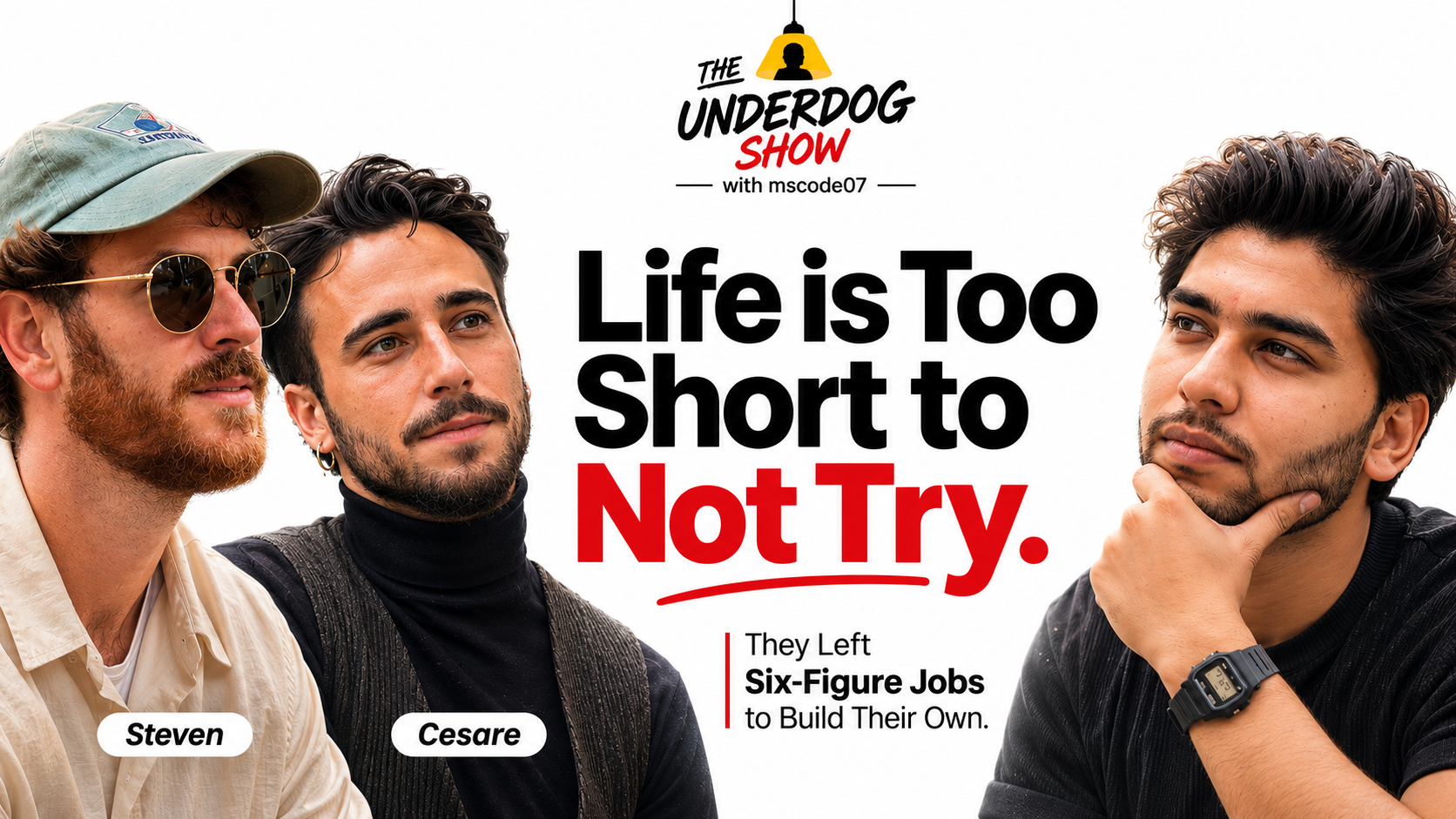
Steven's answer was the line on this episode's cover:
Life is too short to not try.
Cesare offered a practical starting point: create content, find a way to keep doing it, and build from there. If you have already built the product, start finding ways to put it in front of people.
What stayed with me was how openly they talked about the unfinished parts. Leaving corporate life had given them more choice, but it had not removed the difficult work. They still needed to learn how to grow beyond their first customers, and they were building systems around habits they found hard to maintain.
Their story gives me a more useful picture of working with a co-founder: someone who knows your weaknesses, can challenge an idea, and will still be there to work through the next experiment with you.
More from The Underdog Show
This article is based on episode 7, my conversation with Steven and Cesare. Revenue and usage figures reflect what they shared during the interview.
Explore The Underdog Show on YouTube
For another founder's experience with finding customers and giving SEO time, read Brian's journey from CEO to building his own SaaS.